Doctor Qualifications From MBBS to Super‑Specialist (Guide for Medical Representative and Patients)
Doctor Qualifications Explained can feel like a secret code when you walk into a hospital or clinic and see long strings of letters after a doctor’s name, like MBBS, MD, MS, DNB, DM, MCh and more. For most people, these abbreviations are confusing, but understanding them can help you choose the right doctor more quickly, ask better questions, and feel more confident in your healthcare decisions.
This guide breaks down doctor qualifications in simple language, focusing on what they mean for you as a patient and how a doctor’s degree reflects their training journey.
Why understanding Doctor Qualifications matters
Doctor degrees are not just academic labels; they tell a story about the doctor’s level of training, area of expertise and years of experience in that field. A quick look at those letters can help you answer three important questions.
First, you can understand whether the doctor is a generalist (like an MBBS doctor or general physician) or a specialist (like a cardiologist, orthopaedic surgeon or dermatologist). Second, you can see how far they have gone in their training – just MBBS, MBBS plus MD/MS, or MBBS plus MD/MS plus DM/MCh super‑speciality. Third, you can match your problem to the right doctor, which saves time and often leads to a more accurate diagnosis and treatment.
MBBS is the starting point for every doctor
MBBS stands for Bachelor of Medicine, Bachelor of Surgery, and it is the basic medical degree required to become a doctor in India and many other countries. After clearing national or state entrance exams, students enter MBBS, which usually lasts 5.5 years, including one year of compulsory rotating internship.
During MBBS, future doctors study anatomy, physiology, pharmacology, pathology and many other subjects, and they also train in clinical departments like medicine, surgery, pediatrics, obstetrics and gynaecology, and emergency care. Once they complete MBBS and an internship, they can register with the medical council and begin practising as general doctors or junior residents in hospitals. Many MBBS doctors work in clinics, emergencies and primary care, while some move into rural service or government postings before deciding on specialisation.
MD and MS are postgraduate specialisations after MBBS
After MBBS, doctors who want to specialise appear for competitive postgraduate entrance exams and, if selected, join MD, MS or DNB programmes. These are full‑time residency training programs, typically three years long, where doctors focus deeply on a broad speciality and manage patients under senior supervision.
MD (Doctor of Medicine) focuses on non‑surgical or “medical” specialities. Some common MD branches include:
- MD (General Medicine) – adult medical diseases and complex internal medicine problems.
- MD (Pediatrics) – health problems of babies, children and adolescents.
- MD (Dermatology) – skin, hair and nail diseases.
- MD (Psychiatry) – mental health and psychiatric disorders.
- MD (Anesthesiology) – anaesthesia and intensive care.
- MD (Radiodiagnosis) – diagnostic imaging such as X‑ray, CT and MRI.
MS (Master of Surgery) focuses on surgical specialities where operations are a central part of treatment. Common MS branches include:
- MS (General Surgery) – broad surgical procedures, including abdomen and soft tissues.
- MS (Orthopaedics) – bones, joints and spine surgery.
- MS (Obstetrics & Gynaecology) – pregnancy, childbirth and women’s reproductive surgery.
- MS (Ophthalmology) – eye diseases and eye surgery.
- MS (ENT) – ear, nose and throat surgery.
For patients, a doctor with MBBS plus MD or MS is a specialist who has undergone at least eight and a half years of training from the time they entered MBBS, not counting any extra senior residency or fellowships they may do later.
DNB is the national board route to becoming a specialist
Apart from MD and MS, there is another recognised route called DNB, which stands for Diplomate of National Board. These programmes are run by the National Board of Examinations and are offered in accredited teaching hospitals across India.
DNB training is also usually three years long and covers a wide range of medical and surgical specialities similar to MD and MS, such as DNB (Medicine), DNB (Pediatrics), DNB (Orthopaedics) and many others. The exit exams are centralised and considered rigorous, and in most contexts, DNB is treated as equivalent to MD/MS for practice and teaching after fulfilling the required criteria.
So, when you see “DNB” after a doctor’s name, you are still dealing with a specialist who has completed structured postgraduate training and passed national‑level examinations in that speciality.
DM, MCh and DNB SS – super‑specialists at the top of the ladder
Once a doctor has already completed an MD, MS or DNB, they can go a step further and pursue super‑speciality training. These advanced programmes deepen expertise in a narrow area, creating what most patients call “super‑specialists”.
DM (Doctor of Medicine) is a super‑speciality degree in medical branches. Popular DM specialities include:
- DM (Cardiology) – heart diseases, complex interventions and advanced cardiac care.
- DM (Neurology) – brain, spinal cord and nerve disorders.
- DM (Gastroenterology) – diseases of the stomach, intestine, liver and pancreas.
- DM (Nephrology) – kidney diseases and dialysis‑related conditions.
- DM (Endocrinology) – hormone and metabolic disorders like diabetes and thyroid disease.
- DM (Medical Oncology) – chemotherapy and systemic cancer treatments.
MCh (Master of Chirurgiae) is a super‑speciality degree on the surgical side. Examples include:
- MCh (Neurosurgery) – brain and spine surgery.
- MCh (Urology) – urinary tract and male reproductive surgery.
- MCh (Cardiothoracic & Vascular Surgery) – heart and major vessel surgery.
- MCh (Surgical Gastroenterology) – gastrointestinal and liver‑related advanced surgeries.
The National Board also offers DNB Super Speciality (DNB SS) programmes, which are the DNB equivalents of DM and MCh in many super‑speciality branches. These programmes take around three years after MD/MS/DNB, meaning a DM, MCh or DNB SS doctor has usually spent more than a decade in structured medical training after joining MBBS.
For patients, a DM or MCh doctor is generally the right person to see for very complex or rare conditions in their niche, such as complicated heart disease, advanced neurological problems, or cancers that need highly specialised care.
Common abbreviations you see on clinic boards (and what they mean)
Here is a quick, patient‑friendly “cheat sheet” that you can mentally refer to whenever you see a doctor’s nameplate.
| What you see on the board | Full form | What does it mean for you as a patient |
|---|---|---|
| MBBS | Bachelor of Medicine, Bachelor of Surgery | Basic medical doctor; can diagnose and treat common illnesses and emergencies |
| MBBS, MD (Medicine) | MBBS + Doctor of Medicine in General Medicine | Specialist physician for adult medical problems and complex internal diseases. |
| MBBS, MD (Pediatrics) | MBBS, MD (Pediatrics) | Child specialist for babies, children and teenagers. |
| MBBS, MS (General Surgery) | MBBS + Master of Surgery – General Surgery | Specialist surgeon for general surgical operations. |
| MBBS, MS (Orthopaedics) | MBBS + Master of Surgery – Orthopaedics | Bone and joint surgeon, including fractures and joint replacements. |
| MBBS, MD (Dermatology) | MBBS + Doctor of Medicine – Dermatology | Skin, hair and nail specialist. |
| MBBS, MD (Psychiatry) | MBBS + Doctor of Medicine – Psychiatry | Mental health and psychiatric disorders specialist. |
| MBBS, MD (Radiodiagnosis) | MBBS + Doctor of Medicine – Radiodiagnosis | Imaging specialist for X‑ray, CT, MRI and ultrasound reports. |
| MBBS, MD (Anesthesiology) | MBBS + Doctor of Medicine – Anesthesiology | Anaesthesia, pain relief and ICU care specialist. |
| MBBS, DNB (Medicine/Surgery etc.) | MBBS + Diplomate of National Board (speciality) | Specialist via national‑board route, equivalent to MD/MS in many settings. |
| MBBS, MD (Medicine), DM (Cardiology) | MBBS + MD + DM in Cardiology | Super‑specialist heart doctor, often in tertiary care hospitals. |
| MBBS, MS (Surgery), MCh (Neurosurgery) | MBBS + MS + MCh in Neurosurgery | Super‑specialist brain and spine surgeon. |
| DNB SS (Cardiology/Neurology etc.) | DNB Super Speciality | Super‑specialist via national‑board route. |
Even this simple mapping helps you quickly understand who is a general doctor, who is a specialist and who is a super‑specialist in a very narrow field.
Frequently Asked Questions About Doctor Qualifications
1 . What is the highest degree for doctors?
In clinical practice, super‑speciality degrees like DM, MCh and DNB SS are among the highest levels of formal clinical training
2 . Is MD higher than MBBS?
Yes. MBBS is the basic medical degree, while MD is a postgraduate specialist degree done after MBBS
3 . Which is higher – MD or DM?
DM is considered a super‑speciality degree, usually done after MD, so it is a higher and more specialised qualification
4 . Is DNB equal to MD or MS?
In most contexts, DNB in broad specialities is treated as equivalent to MD/MS for practice and, with certain criteria, for teaching posts as well
5 . Who should I see first – a general physician or a super‑specialist?
For most problems, it is better to see a general physician or MBBS doctor first, who can then refer you to the right specialist or super‑specialist if needed
🎯 Key Takeaway
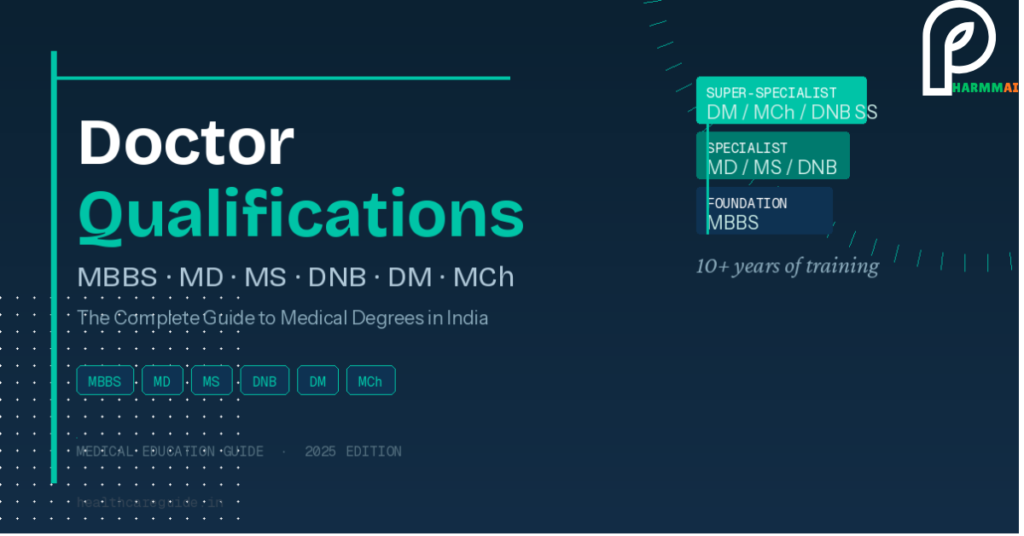
Doctor qualifications in India follow a logical three-tier structure: MBBS (foundation generalist), MD/MS/DNB (specialist), and DM/MCh/DNB SS (super-specialist). Each tier requires completing the one below it, meaning the most qualified super-specialists have devoted over a decade to formal training. Knowing these 7 essential doctor qualifications helps you choose the right doctor at the right time — and approach your healthcare with confidence and clarity.